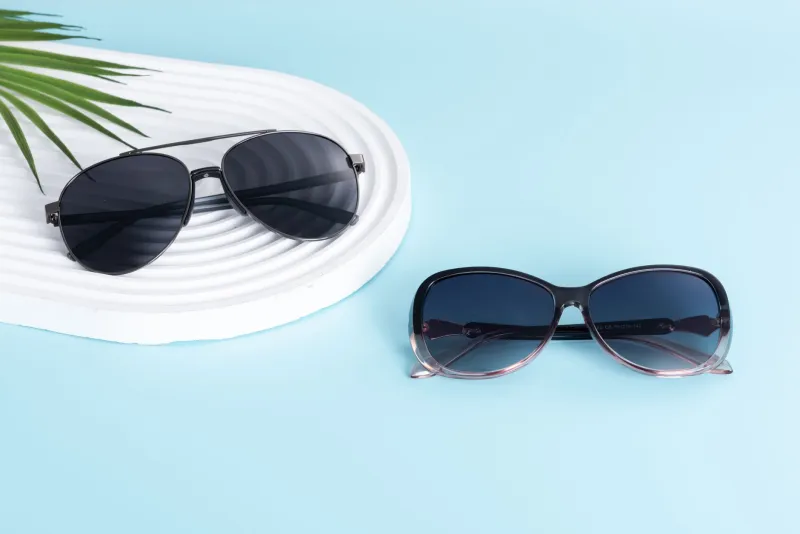
Slipping, Pinching, Sliding: How to Finally Get Your Aviators to Fit Right

You paid good money for a pair of aviators. They looked incredible in the mirror at the store. But somewhere between the checkout counter and your actual life — your morning commute, a weekend hike, a long afternoon at an outdoor concert — things went sideways. Literally. They're sliding down your nose before you've even hit the highway, or they're pinching your temples hard enough to give you a headache by noon.
Here's the thing: this is way more common than people talk about. Fit problems are probably the number one reason people quietly stop wearing sunglasses they otherwise love. And with aviators specifically, the design creates some unique challenges that other frame styles don't have. The good news? Most of these issues are completely fixable.
Why Aviators Are a Fit Challenge in the First Place
Aviators were originally engineered for military pilots in the 1930s — people who needed their eyewear to stay put at high altitude while also fitting under a flight helmet. That heritage means the frame geometry is built around function, not universal face-fitting comfort. The large teardrop lenses create more wind resistance than smaller frames. The double bridge is rigid by design. And the nose pads — those little adjustable arms that sit on either side of your nose — are doing a lot of heavy lifting.
All of that means a small misalignment anywhere on the frame gets amplified in ways you'd never notice with a simpler style. Let's break down the most common problems one by one.
Problem 1: Frames Keep Sliding Down Your Nose
This is the classic aviator complaint. You push them up, they slide back. You push them up again. It's exhausting.
The culprit is almost always the nose pads. On most metal aviator frames, the nose pads are adjustable — they're attached to small metal arms that can be gently bent inward or outward. If the pads are sitting too wide apart, your frames will have nothing to grip and will migrate south all day long.
DIY fix: Use your thumbs to very gently squeeze the nose pad arms inward, just a millimeter or two at a time. You want the pads to rest snugly against the sides of your nose bridge without digging in. Test the fit after each small adjustment. If you're nervous about bending the metal, most optical shops and even some LensCrafters locations will do this adjustment for free in under five minutes.
Also worth checking: are the temples (the arms that go over your ears) long enough? If they're too short, the frames will constantly be trying to push themselves forward off your face.
Problem 2: They're Pinching or Leaving Marks on Your Nose
The opposite problem — and just as annoying. If you're ending the day with little red dents on either side of your nose, your nose pads are too tight.
DIY fix: This time, gently push the nose pad arms outward to create a bit more space. Again, small adjustments are key. You're aiming for a fit that feels like the pads are barely there — present enough to hold the frames up, but not so aggressive that you feel them constantly.
If you're dealing with skin irritation beyond just pressure marks, the pad material might be the issue. Standard metal-tipped pads or hard plastic pads can cause reactions on sensitive skin. Look for replacement silicone nose pads, which are cheap (usually under $10 for a multipack on Amazon) and dramatically more comfortable. They also grip better, which helps with the sliding problem too.
Problem 3: One Side Sits Higher Than the Other
You look in the mirror and your aviators are crooked — one lens noticeably higher than the other. This feels like a defect, but it's almost never the frame's fault. Most people's ears are not perfectly symmetrical, and most people's noses aren't either. Frames get adjusted to compensate for that.
DIY fix: Identify which temple arm needs to angle downward slightly to level the frames. Very carefully bend the arm down at the hinge end (where it meets the frame front) or at the tip (where it curves behind your ear). Go slowly. Metal bends more than you think, and you can't un-bend it easily if you go too far.
If the asymmetry is significant, this is a job for an optician. A good optical shop can assess the fit from multiple angles and make precise adjustments that are hard to replicate at home.
Problem 4: The Temples Are Too Tight (or Too Loose)
Temple fit is about more than just length — it's about the curve. The temple arms on aviators should curve gently around the back of your ear, not press against the side of your head or stick straight out.
Too tight? The arms are bending too sharply before they clear your ear. Too loose? They're not curving enough and the frames are basically just resting on your nose with no rear support.
DIY fix: For metal frames, you can carefully bend the temple tips to adjust the curve. Use both hands and apply even pressure. For acetate or plastic frames, warming the arm slightly with a hairdryer (on low, for just a few seconds) makes the material more pliable and easier to reshape without cracking.
When to Skip the DIY and See a Pro
Not every fit issue is a home repair job. If your frames are titanium (which is extremely springy and hard to permanently reshape), if you've already made adjustments and things have gotten worse, or if you're dealing with a high-end pair worth $200 or more, just go see an optician. Most will adjust frames you didn't buy from them for a small fee — or sometimes for free if you're a friendly face.
Many Warby Parker locations, independent optical shops, and mall-based eyewear chains across the US offer walk-in frame adjustments. It takes about five minutes and the difference can be night and day.
The Right Fit Is Worth Chasing
A properly fitted pair of aviators doesn't just feel better — it looks better. Frames that sit where they're supposed to sit frame your face the way they were designed to. The lens coverage lands in the right spot. The proportions work. And honestly, you just carry yourself differently when you're not constantly reaching up to push your shades back into place.
Don't let a fixable fit issue be the reason a great pair of frames ends up forgotten in a drawer. A few minutes of adjustment — or a quick trip to your local optical shop — can completely change the experience.