Grandpa's Shades Might Be a Goldmine: How to Handle Inherited Aviators Like a Pro
You're cleaning out a parent's closet, digging through an old military trunk, or maybe just poking around in the attic on a rainy Sunday afternoon. Then you find them — a battered leather case or a folded bandana wrapped around something metal. You pop it open, and there they are: a pair of aviator sunglasses that look like they've seen some things.
Before your brain jumps straight to "cool prop for Halloween" or "maybe Goodwill?" — pump the brakes. Vintage aviators, depending on their age, maker, and condition, can be surprisingly valuable. And even if they're not worth a fortune, knowing their story makes them infinitely more interesting to wear or display. Let's walk through how to handle this find the right way.
First Things First: Don't Clean Them Yet
Seriously — step away from the Windex. One of the most common mistakes people make when they discover old sunglasses is immediately wiping them down with whatever's nearby. Harsh chemicals can strip original coatings, damage vintage lens tints, and erase the natural patina that collectors actually prize. A quick, dry wipe with a soft cloth is fine if you need to see them clearly. Beyond that, hold off until you know what you're dealing with.
Same goes for bending or adjusting the frames. Vintage metal — especially older gold-filled or aluminum alloy construction — can be brittle. What looks like a minor tweak could snap a temple arm that's worth more intact.
Reading the Clues: What Era Are These From?
Aviators have been around since the late 1930s, so the first step is narrowing down the decade. Here are a few quick visual cues:
1940s–1950s: Frames tend to be heavier, with thick metal construction and lenses that lean toward a true teardrop shape. Military-issue pieces from this era often have stamped markings on the inside of the temple arms — look for "USN," "USAF," or a contract number.
1960s–1970s: This is the golden era for iconic civilian aviators. Brands like Ray-Ban (then owned by Bausch & Lomb) were producing their most collectible models. Frames got slightly slimmer, and you'll often see double or triple bridge designs. Gradient lenses — darker on top, lighter on the bottom — were hugely popular.
1980s–1990s: Frames started incorporating more gold-tone finishes and oversized proportions. Some of the flashier styles from this period are coming back into collector favor, though they haven't peaked the way earlier decades have.
If you see any engravings, stamps, or etched logos, photograph them before anything else. That information is your biggest clue to maker and model.
The Brand Question: Does the Name Matter?
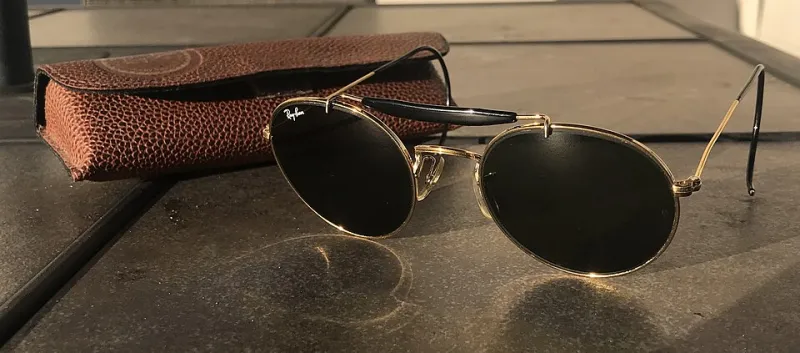
Short answer: absolutely. A pair of Ray-Ban Bausch & Lomb Outdoorsman aviators from the 1960s in good condition can fetch anywhere from $150 to over $500 on the collector market. Military-contract Randolph Engineering frames, American Optical aviators, and early Serengeti models also carry real value among enthusiasts.
Generic or unbranded frames from the same era? Much less so — though they can still be charming conversation pieces.
Bausch & Lomb Ray-Bans are particularly easy to identify: look for the B&L logo etched into the lens itself (not just on the case or box). That etching is a key authentication marker that fakes almost never replicate correctly. If yours has it, you might be sitting on something genuinely special.
Randolph Engineering, still made in Milford, Massachusetts to this day, has been supplying the U.S. military for decades. Older military-issue Randolphs often have date codes stamped into the frame — a detail that serious collectors use to pinpoint exact production years.
Understanding Condition Grades (Without Being a Collector)
The vintage eyewear world uses a rough grading scale that's worth knowing:
- Mint / New Old Stock (NOS): Unworn, possibly still in original packaging. These command the highest prices.
- Excellent: Light signs of age, no significant scratches on lenses, original hardware intact.
- Very Good: Minor wear, possibly a small lens scratch or slight frame patina, but fully functional.
- Good: Noticeable wear, possible lens haze or replaced nose pads, still structurally sound.
- Fair / Display Only: Significant damage, heavy scratching, bent or repaired frames.
Be honest with yourself about where your find lands. Overstating condition is the fastest way to embarrass yourself on a resale platform or get into a dispute with a buyer.
Should You Wear Them, Sell Them, or Restore Them?
This is genuinely a personal call, but here's a framework:
Wear them if: They're in excellent or very good condition, the lenses are optically clear (no hazing or deep scratches), and the sentimental connection is strong. Vintage aviators that actually belonged to a family member carry a kind of cool that no new pair can replicate. Just get the lenses checked — older UV coatings may not meet modern standards, so you might want to have them replaced by an optical professional who specializes in vintage frames.
Sell them if: They're in mint or near-mint condition and you're not emotionally attached. The collector market for quality vintage aviators is active, especially on platforms like eBay, Etsy's vintage section, and dedicated eyewear collector forums. Do your research on comparable sold listings before you price anything.
Restore them if: The frames are structurally excellent but the lenses are shot. A skilled optician or vintage eyewear restorer can often fit new lenses — including polarized options — into original frames, giving you a wearable piece that honors the original. This is the move for frames with real sentimental value but compromised optics.
Where to Get a Real Valuation
If you think you've got something genuinely rare, don't rely solely on a quick Google search. A few better options:
- Vintage eyewear dealers: Search for shops that specialize in vintage or antique eyewear. Many will offer free appraisals in exchange for first right of refusal if you decide to sell.
- Online collector communities: Reddit's r/sunglasses and dedicated vintage eyewear Facebook groups are surprisingly knowledgeable. Post clear photos and you'll usually get honest feedback within hours.
- Auction house specialists: For potentially high-value military or early civilian pieces, a specialist at a smaller auction house can give you a ballpark figure without commitment.
The Bigger Picture
There's something genuinely satisfying about discovering that an old pair of sunglasses isn't just an old pair of sunglasses. Whether what you found turns out to be a $30 curiosity or a $400 collector's piece, taking the time to understand it connects you to a real slice of American history — from WWII cockpits to the open highways of the 1970s.
Aviators have always been about more than just blocking the sun. They've been about attitude, identity, and a certain kind of American confidence. If a pair of them has been sitting in your family's attic for decades, maybe they've just been waiting for someone to finally appreciate what they represent.
That someone might as well be you.