From Cockpits to Closeups: How Hollywood Pilots Turned Aviators Into America's Forever Sunglasses
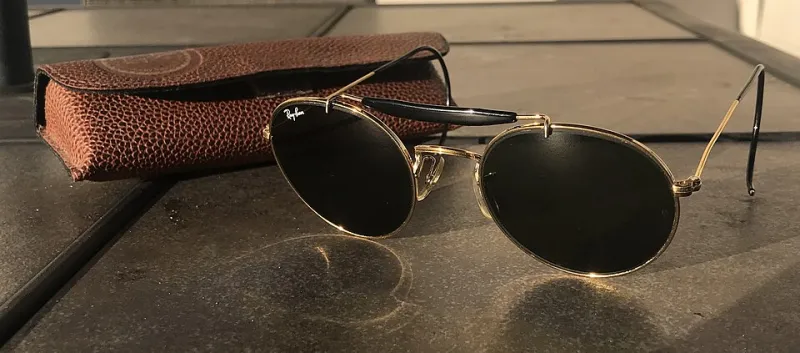
Photo: Tyrol5, CC BY-SA 4.0, via Wikimedia Commons
There's a moment in almost every great American pilot film where the hero slides on a pair of aviators, squares their jaw, and stares into the horizon. You know the shot. It's been burned into our collective memory so many times that the frame itself — teardrop lenses, thin metal bridge, temple arms catching the light — has come to mean something beyond just eye protection. It means confidence. It means authority. It means cool in a way that very few accessories have ever managed to sustain across multiple generations.
But how did we get here? And why do aviators keep coming back every time a new generation of Americans discovers them on screen?
The Original Blueprint: Military Roots Meet Movie Magic
Aviator sunglasses didn't start in Hollywood. They started in the Army Air Corps. Back in 1936, Bausch & Lomb developed the original teardrop-shaped frames for military pilots who needed wide-field vision at high altitudes where UV exposure is dramatically more intense than at ground level. The design was purely functional — large lenses to block peripheral glare, lightweight metal frames that worked under a flight helmet.
But functionality has a funny way of looking good. When WWII-era newsreels and photographs started circulating images of American pilots in their gear, those sunglasses were right there in frame. Generals wore them. Aces wore them. The guys who were winning the war wore them. By the time Hollywood started dramatizing those stories in the late 1940s and through the 1950s, the aviator was already loaded with meaning — and the film industry knew exactly how to use that.
Early war films leaned hard into the aesthetic. The sunglasses became shorthand for a certain kind of American masculinity: disciplined, capable, a little dangerous. Audiences didn't need a backstory to understand what those frames communicated. The visual language was already established.
Top Gun and the Retail Earthquake Nobody Saw Coming
If there's one film that single-handedly moved product, it's the 1986 original Top Gun. The numbers are almost absurd to look back on. Within weeks of the film's release, aviator sales in the US reportedly spiked by around 40 percent. Optical retailers couldn't keep Ray-Ban Aviators on shelves. The film's costume department had essentially done more for one sunglass style than any marketing campaign in history.
What made it work so effectively wasn't just that Tom Cruise looked good — though that certainly didn't hurt. It was that the film treated the aviators as part of a total identity package. Maverick's sunglasses weren't a prop; they were an extension of his character. They were on during the volleyball scene, during the motorcycle rides, during the confrontations with authority. They were present in moments of triumph and moments of grief. The audience didn't consciously register that they were being sold something. They just knew they wanted to feel what Maverick felt.
That's the real genius of how Hollywood uses aviators. It's not product placement in the traditional sense. It's identity placement.
The Pattern Keeps Repeating — And It's Not an Accident
Top Gun wasn't a one-off. Look at the broader pattern and you'll see the same dynamic playing out across decades.
The Men in Black franchise put Will Smith in sleek black aviator-adjacent frames and made them look futuristic and untouchable. The Mission: Impossible series has used aviators and close relatives to signal that Ethan Hunt operates in a different league. Even non-pilot films have borrowed the visual shorthand — think of how many times you've seen a character in a thriller or an action movie reach for a pair of metal-frame shades when they want to project control.
And then Top Gun: Maverick hit theaters in 2022 and the whole cycle kicked off again. Searches for aviator sunglasses spiked. Ray-Ban reported strong sales momentum. Vintage frames started showing up on resale platforms at premium prices. A generation of younger American consumers who had maybe grown up hearing about the original film but never fully connected with it suddenly had their own version of that iconic moment — and they went shopping.
This is the aviator effect in action. The film creates cultural permission. It tells a new audience: these frames are cool right now, and here's exactly how to wear them. Retail follows.
Why Aviators Specifically? The Psychology Behind the Frame
It's worth asking why aviators have this recurring power when other sunglass styles don't. Wayfarers had their moment. Cat-eyes have their devotees. Round frames cycle in and out with bohemian trends. But none of them have the same consistent Hollywood gravitational pull that aviators do.
Part of it is the association with actual expertise. Pilots are trained professionals operating in high-stakes environments. The sunglasses carry that connotation. When a character wears aviators on screen, there's an implicit suggestion that they know what they're doing — that they've earned the right to that frame.
Part of it is also the universality of the silhouette. The teardrop shape is genuinely flattering across a wide range of face structures. It's a frame that doesn't demand a specific look from the wearer. Hollywood can put them on a square-jawed action hero or a cerebral scientist or a rebellious outsider, and the glasses work in each context.
And part of it — probably the biggest part — is that the original design is so well-resolved that it hasn't needed to change. The aviator you can buy today is recognizably the same object that pilots wore in 1944. That continuity is rare in fashion, and it gives the frame a kind of timeless credibility that trends can't manufacture.
What This Means When You're Actually Shopping
Understanding the Hollywood connection to aviators isn't just interesting cultural trivia — it's practically useful when you're deciding what to buy.
When you see a major pilot film or a streaming series featuring aviators prominently, expect prices on popular models to climb temporarily and stock to thin out on the most recognizable styles. If you're a Ray-Ban Aviator Classic person, buying between pop culture moments is almost always smarter than trying to get a pair during peak hype.
It's also worth knowing that the Hollywood-driven demand cycle tends to favor the most recognizable, historically accurate versions of the frame. The classic gold or silver wire frame with G-15 green lenses isn't just an aesthetic preference — it's the version that looks most like what you saw on screen, and it holds its appeal long after a specific film's moment has passed.
Finally, don't underestimate the staying power of this cycle. The aviator has now survived multiple generations of pop culture, each one discovering the frame fresh and falling for it all over again. Whatever the next big pilot film turns out to be, aviators will be there — and so will the spike in demand that follows.
The cockpit and the closeup have been in conversation for nearly a century now. That's not a coincidence. That's a design so good that even Hollywood can't stop reaching for it.